
How to Start a Saree Reselling Business Online Using WhatsApp & Instagram
THE MOSIN JOURNAL / BUSINESS GUIDE
A practical guide to selling sarees through WhatsApp and Instagram—without buying boxes of stock first.
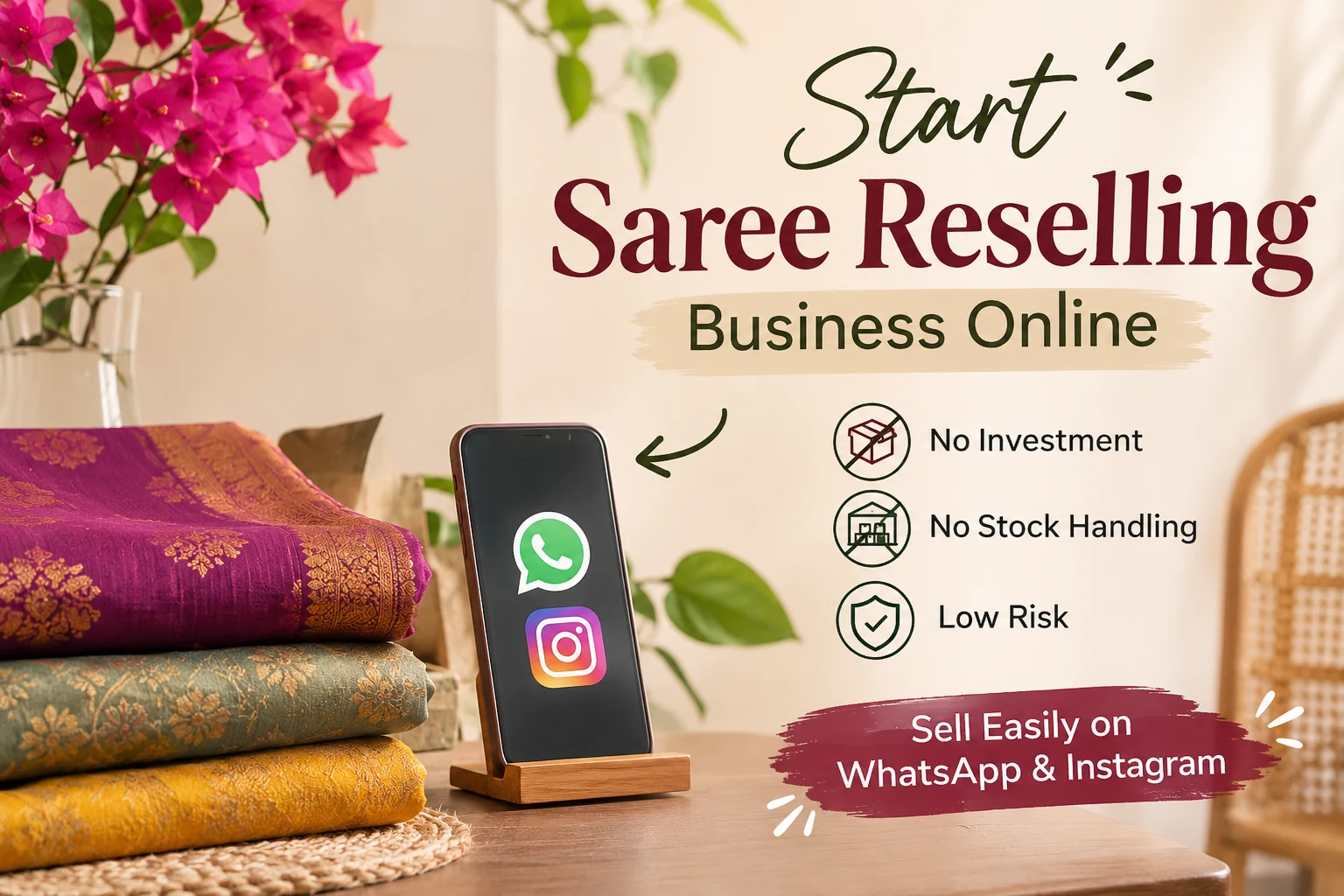
An easy-to-follow overview of promoting sarees online without purchasing inventory in advance.
You see a beautiful cotton saree in a supplier’s WhatsApp group. A few minutes later, you share the photograph with your own customers—this time with your selling price. Someone replies, “Is this available?” That small conversation could be the beginning of a saree business.
For women who want to earn from home without buying bundles of stock, a saree reselling business online can be a practical way to test an idea. You choose designs, promote them through WhatsApp or Instagram, take enquiries and coordinate orders with a supplier who has agreed to fulfil them.
This guide focuses on the photo-sharing, margin-based model: what the supplier sends, exactly what the reseller changes, how orders move, how to price responsibly, and the mistakes to avoid.
If you are exploring a saree reselling business online, begin by understanding how the supplier shares catalogue details and how you present them to customers.
What is a saree reselling business online?
In a stock-free resale arrangement, a saree vendor keeps the product inventory while an independent reseller finds buyers. The vendor shares product photographs, material details, available colours, product codes and a vendor price through WhatsApp or an agreed channel. The reseller uses authorised media to market the saree at a customer-facing price that includes her margin.
A reseller can begin by sharing designs with a small, interested customer group. When a buyer chooses a saree, the reseller confirms availability and passes the order details to the vendor. Whether the vendor packs and dispatches directly, and how payments and returns work, must be agreed in advance.
How the WhatsApp and Instagram reselling model works
A well-organised supplier makes the process easier by sharing a complete catalogue post—not only a picture. Every post should include the actual fabric type, saree length, blouse-piece details, product code, vendor rate and availability.
The reseller can then follow this workflow:
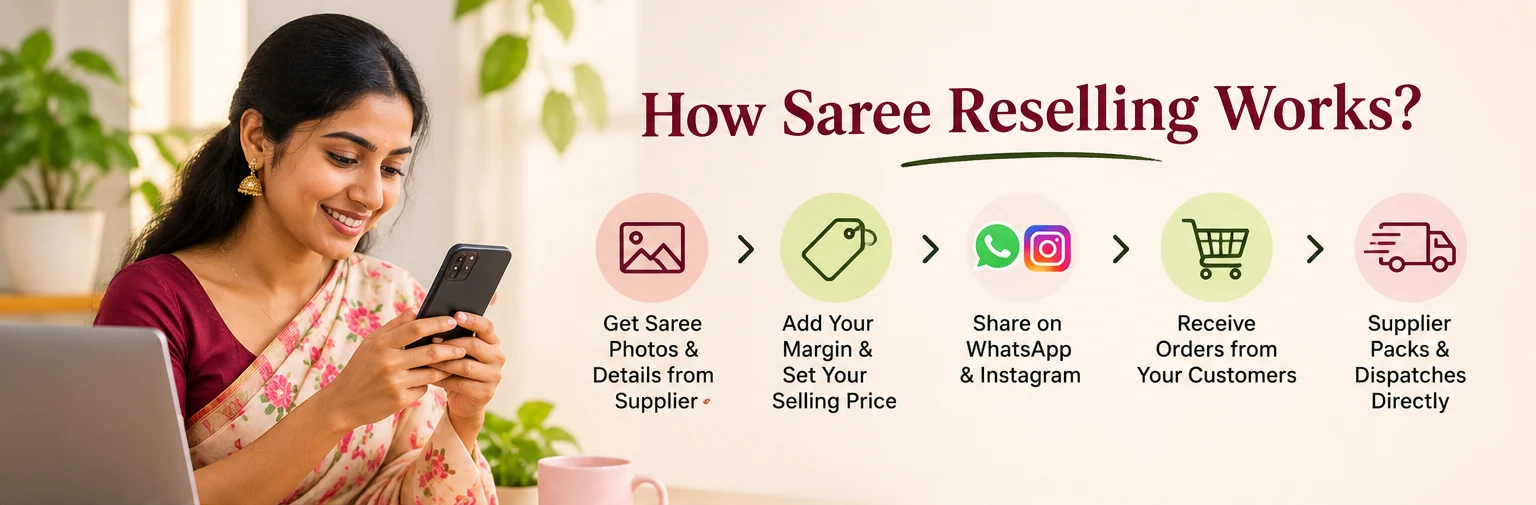
Each step matters: use authorised supplier media, change your selling price, confirm stock and follow agreed dispatch terms.
- 1. Receive the product post. The supplier shares images and descriptions in the authorised reseller group or channel.
- 2. Choose suitable sarees. Select styles your customers actually ask for—cotton for everyday wear, light fabrics for office use or festive designs for occasions.
- 3. Change the price. Replace the vendor price in the customer caption with your retail price. Include your margin and any costs you must bear.
- 4. Share with interested buyers. Post to a permission-based WhatsApp group or Status, or create an Instagram post or Reel using media you are allowed to publish.
- 5. Confirm availability. Before collecting payment, check that the requested colour and product code are still in stock.
- 6. Complete the order. Follow the vendor’s agreed process for payment, address details, dispatch and tracking.
- 7. Support your customer. Share updates, answer questions and follow the agreed damage, exchange and return process.
The most important step: change the price before forwarding
This is where many beginners make a mistake. A supplier’s WhatsApp caption may show a wholesale or vendor price. Do not forward that amount unchanged to your customers. Prepare a separate customer caption using the selling price you have chosen.
Here is an illustrative example of the same saree described in two different messages:
For a saree reselling business online, the price you share with customers should cover your costs while keeping fabric and availability details accurate.
| SUPPLIER CAPTION — NOT FOR CUSTOMERS | YOUR CUSTOMER CAPTION — READY TO SHARE |
|---|---|
| Vendor message (private) Product: Soft cotton saree Code: CT-104 Colour: Bottle green Fabric: Cotton blend Blouse: Included, unstitched Vendor price: ₹750 | Reseller message (customer-facing) New arrival: Soft cotton saree Code: CT-104 Colour: Bottle green Fabric: Cotton blend Blouse: Included, unstitched My selling price: ₹999 DM for availability & delivery details. |
Example gross difference: ₹999 − ₹750 = ₹249. This is not guaranteed profit. Courier, payment charges, refunds, promotions or other expenses may reduce your actual earnings. Confirm which costs are included in the vendor rate before publishing your price.
What details must stay accurate?
You may change your selling price and your own contact information. Do not change the material composition, brand claims, authenticity, dimensions or product availability just to make an offer more attractive. If a fabric is a blend, do not call it “pure cotton.” If the listing does not confirm handloom production, do not label it handwoven.
Selling sarees through WhatsApp: a simple daily routine
For a saree reselling business online, WhatsApp is useful when customers already know you or have chosen to receive your updates. Start with a complete WhatsApp Business profile, then organise interested buyers by the styles they prefer.
- Morning: check the supplier’s new collection and current stock.
- Afternoon: share three to five suitable designs with accurate prices; avoid flooding groups with every catalogue post.
- When someone enquires: send close-up images, fabric information, delivery estimate and final payable amount.
- After confirmation: write down the product code, customer name, address, payment status and vendor order reference.
- After delivery: ask whether the product arrived as described, and invite feedback without pressuring the buyer.
Use WhatsApp Business features such as labels, catalogue tools and quick replies where they suit your workflow. Follow WhatsApp’s messaging policies and avoid adding people to marketing groups without their permission.
Selling sarees on Instagram: posts, carousels and Reels
Instagram can help a saree reselling business online reach shoppers beyond existing contacts. Your feed does not need to look like a large fashion brand. It needs clear visuals, consistent product information and a reliable way for people to order.
A useful carousel might contain a full-saree photograph, border close-up, pallu detail, fabric information and a final slide explaining how to enquire. A short Reel can show the drape and movement of a saree—but only if the supplier permits reuse of that video or you have created it yourself.
Use a caption that answers common questions: fabric, blouse piece, available colour, price, estimated delivery and how to order. Put your actual customer price in the description. If a design sells out, update the post or tell buyers promptly.
Do you need to buy saree stock first?
In a supplier-supported saree reselling business online, the goal is to sell from authorised catalogue images without purchasing a bundle of sarees in advance. That removes the biggest inventory problem for many beginners: money tied up in unsold pieces.
But the conditions depend on the vendor. Some suppliers sell only in bulk; others allow single-piece orders or supplier-direct dispatch. Ask about order minimums, dispatch responsibility, customer invoices, payment settlement and returns before you begin.
| APPROACH | WHAT IT MEANS |
|---|---|
| Buying inventory first | You purchase sarees, store them, photograph them and ship each order yourself. |
| Supplier-supported resale | You promote authorised product posts and coordinate sales while stock remains with the vendor, subject to agreed fulfilment terms. |
| Main trade-off | Less stock exposure, but more dependence on the vendor’s accuracy, availability and shipping process. |
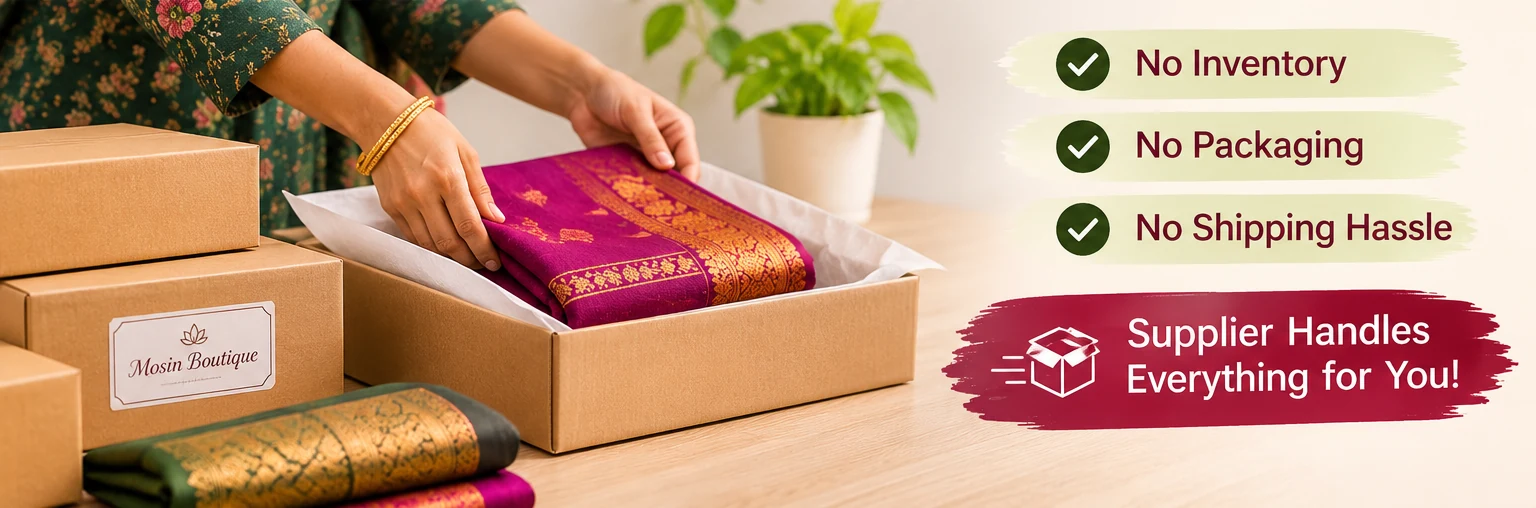
Packing and direct delivery are handled by the supplier only when included in the agreed reselling arrangement.
How to choose a saree supplier you can trust
For a saree reselling business online, supplier reliability matters as much as the designs themselves. An attractive catalogue is not enough. Before promoting the first product, clarify these questions:
- Are the photographs and videos approved for reseller use on WhatsApp and Instagram?
- Are prices for resellers clearly distinguished from customer-facing prices?
- Can the vendor dispatch a single piece, or is there a minimum quantity?
- How often are stock and colour availability updated?
- Who collects customer payments, and when is the reseller’s margin settled?
- Who pays for shipping, failed delivery, returns or damaged items?
- What seller or invoice information appears in the parcel?
- What is the process for sharing tracking details and resolving complaints?
Where possible, keep these terms in writing. Test the communication process with a small number of enquiries and orders before promising fast delivery to a larger audience.
How much margin should a beginner keep?
There is no universal margin for a saree reselling business online. A ₹200 margin may work for one product but become too small when shipping and payment expenses are added. A higher margin may be reasonable for a differentiated item with stronger presentation or service.
Start with this simple calculation: customer selling price = vendor rate + your intended margin + any extra costs you are responsible for. Confirm whether quoted supplier rates already include tax and delivery. If you are registered for GST, use the tax treatment appropriate to your business rather than treating all of the difference as profit.
Keep a basic spreadsheet with product code, vendor rate, customer price, shipping charges, payment status, and the amount actually earned after the order is completed.
Common mistakes new resellers should avoid
- Sharing the vendor price by mistake. Always prepare a separate caption with your customer-facing price.
- Collecting money before checking stock. Product availability can change quickly.
- Using photographs without permission. Confirm the vendor allows the media to be republished on your channels.
- Making unsupported fabric claims. Describe the product exactly as the supplier has verified it.
- Ignoring delivery and return policies. Explain realistic terms before the customer pays.
- Posting too many products. Focus on designs relevant to your audience instead of forwarding every message.
- Calling the business risk-free. Although unsold stock may not be your responsibility, customer complaints, delayed deliveries and expenses can still arise.
Before growing a saree reselling business online, check the vendor’s order, replacement and delivery terms so your customers know what to expect.
A realistic 7-day plan to begin from home
| DAY | WHAT TO DO |
|---|---|
| Day 1 | Choose your audience: office cotton sarees, daily wear, festive sarees or another clear niche. |
| Day 2 | Review suppliers and confirm photo use, margins, dispatch, payment and return terms. |
| Day 3 | Set up WhatsApp Business and an Instagram professional account with clear contact information. |
| Day 4 | Prepare five accurate, customer-facing product captions. Remove the supplier rates. |
| Day 5 | Share the first selection with interested contacts; answer questions and record enquiries. |
| Day 6 | Review which products drew interest. Confirm stock before taking any order. |
| Day 7 | Improve captions and your order checklist based on what customers asked. |
The first week of a saree reselling business online is for learning, not a promise of immediate sales. A small, engaged audience and accurate product information are more valuable than posting dozens of random sarees.
Your first week of a saree reselling business online can focus on building a clear routine rather than posting hundreds of products.
Start with Mosin Boutique’s reseller information
If you would like to explore how Mosin Boutique works with resellers, visit our Become a Reseller page. Review the current participation details, available collections and ordering procedure before getting started.
You can also browse our Kanchi Cotton Sarees and Vazhai Pattu Sarees to understand the styles customers might enjoy. For ideas on describing textile traditions, read our guide to handloom sarees in Tamil Nadu.
Frequently asked questions about saree reselling
Can I start a saree reselling business online without buying stock?
Yes, if your chosen supplier supports a model where you promote authorised product images and place orders only after a customer confirms. No inventory purchase does not mean zero operating expense or zero business risk.
How do I earn from WhatsApp saree reselling?
The reseller shares an accurate product caption with a customer-facing price that includes an agreed margin. The real earnings depend on vendor costs, shipping, fees, returns and successful order completion.
Can I forward the supplier’s saree photos directly?
Only if the supplier permits you to reuse them. Update the customer caption with your selling price and contact information, and preserve accurate fabric details.
Can I post the same saree images on Instagram?
Use only images or videos you are authorised to publish. Prefer a clear carousel or short Reel and keep the final price, fabric, availability and ordering details easy to find.
Who ships the product to my customer?
It depends on your agreement. Some vendors offer direct dispatch; others send the product to the reseller first. Confirm packing, invoicing, delivery and returns before promoting that service.
Is saree reselling completely risk-free?
No. Avoiding inventory reduces the risk of unsold stock, but payment disputes, delayed deliveries, cancelled orders, quality issues and marketing costs are still possible.
Do I need a website to start reselling sarees?
Not necessarily. Some beginners start with permission-based WhatsApp contacts or an Instagram profile. A website can become useful later for organising a larger catalogue and making ordering easier.
How can I become a Mosin Boutique reseller?
Visit the Become a Reseller page to review the current programme and enquiry process. Terms and availability may change, so check the latest details before making commitments to customers.
A small beginning can become a real business
Starting a saree reselling business online does not mean you need a shop, a storeroom or a large first order. What you do need is a trustworthy supplier, accurate captions, thoughtful pricing and a habit of following through on each customer enquiry.
Begin with a handful of designs that suit your audience. Share them clearly, listen to customers and improve the process one order at a time. If the model fits your goals, the Mosin Boutique reseller page is a sensible next place to learn more.